Friday, July 4, 2014

The Virtue of Changemaking

Much has been said about changemaking as an art: We use imagination to visualize the change that we want and let our hands form this vision into something real and tangible. Passion incites consistency and discipline yields results.

I agree to all these things yet, my humble experiences as a head of programs in a start up foundation in the last three years have taught me that changemaking takes more than just skill and creativity; it requires faith. It needs patient trust.

When I entered the foundation in July of 2011, there were several challenges that we had to undertake. We needed to boost program spending, increase the involvement of our principals in our causes, gain awareness about the foundation within and outside its network, and develop new programs that will change mindsets and their corresponding behaviors and impact.

As I took on the challenge, I thought that everything easily operated on a causal basis. If we wanted to boost spending, then we should propose big projects. If we wanted to increase involvement among the family members, then we should keep on sending event invites. If we wanted brand awareness, then we should just maximize corporate communications support from our sister foundation and so on…

In reality, however, change was not as easy as that. My first year was actually quite frustrating. Projects did not get easily approved. In fact, we had to find our own niche, which we could not just pull out of thin air. There were several executive committee and board meetings that left me unfulfilled, wanting and clueless. There were days when tasks were just too overwhelming that I got palpitations. It would have helped if there was somebody else to help me on a full-time basis.

The blessing came under the disguise of a regulator's recommendation to hire another full-time staff. But even finding that staff took three painful tries to finally reveal a gem and a long-time professional partner. Soon, however, the organization began to grow with the addition of more full-time program and administrative staff, plus the inclusion of shared service personnel from a sister foundation.

These days, I can only smile inwardly when I see one of our principals rise from his seat at the center of the table during a board meeting to take a closer look at our program updates and give practical suggestions with his background as a results-driven businessperson. His siblings would then actively trade ideas—sometimes, engaging in light moments—during our regular meetings. They are no longer just involved in the planning process; they join us in influencing stakeholders and they also promote their own causes. Beautifully, they have become the foundation's very own advocates.

It did not take long for some little results and some milestones to slowly reveal themselves. We started to become more specific in our proposals, thereby yielding more approvals that result in actual projects needing significant funding. We began to see many stakeholders within our shared networks with the sister foundation who would nod in recognition of our foundation as a separate and distinct organization. And most importantly, we already saw some positive behavioral changes in some of our target sectors such as the workers in informal sector who are willing to shell out P1,800 to P2,400 a year for health savings instead of their usual vices; employees who choose to line up in the canteen’s healthylicious corner, which our program encouraged to be created; parents and their children who cook and eat more vegetables because of the influence of our projects; and individuals who are ready to commit small, simple yet sustainable actions for the environment.

My whole experience in the foundation allowed me to gain deep respect and appreciation for my superiors and mentors. Both of them are seasoned development workers who have been involved in putting together medium-term development plans for the country and cascading them to the grassroots. I realized that of course, they knew what I had in mind whenever I start talking ambitiously big but at the end of the day, they help me taper these dreams, digestible in bite-sized forms.

In this reflection, I will write some words of wisdom that were derived from an advice that my boss shared during a pocket session. He said that he believes in creating change through incrementalism—small, simple strokes that nonetheless paint the big picture. Whereas a revolutionary approach yields much resistance, incrementalism works carefully for and with people so that over time, they embrace our own advocacies and they become internally changed as well.

Change therefore does not happen overnight. It is a work in progress. We let ideas simmer as we act. We let people accept the change that we advocate for and in the process, we allow ourselves to be changed internally—carefully yet radically. Changemaking is therefore not just an art but a virtue-seeking experience.


Inspired by the Prayer for Patient Trust by Teilhard de Chardin, SJ

Sunday, June 22, 2014

Understanding Our Coping Mechanisms

Here’s a more enlightened view of persons who appear to be unremorseful:

The feeling of guilt can sometimes be so intolerable that it is the ego’s natural reaction to protect itself. Having acted on the whims of the id through a wrongdoing, the ego is subjected to the superego’s voice of reason—our conscience, which may be a very stressful experience. We employ defense mechanisms in order to help us cope.

It is amazing to note the broad range of defenses than an ego can use. It can begin with denial—blocking external events and refusing to face, if not confront the situation, followed by projection, which allows us to attribute our poor judgment to another person. Minimization, on the other hand, lets us downplay the intensity of our mistakes.

 More beautifully, the ego can resort to sublimation or the conversion of guilt and shame into something constructive. It may also be the ego’s way to remind its external reality—family but mostly, friends—of the good deeds that it has done in the past as a way of denying the painful truth. And, it may also be his way of consoling his wearied ego, unconsciously making efforts to compensate for its mistake.

As posted by Joyce on Facebook
14 May 2014

Thursday, April 17, 2014

Reflections from the Ruins
(Remembering Bohol and Cebu after the Earthquake)

I recall waking up to some household commotion about a certain earthquake on October 15, 2013, a non-working holiday: Fe, my daughter's caregiver, was desperate to get in touch with her parents. I turned to the TV and the Internet, and discovered that a 7.2-magnitude earthquake hit the Central Visayas region, severely affecting the provinces of Bohol and Cebu.

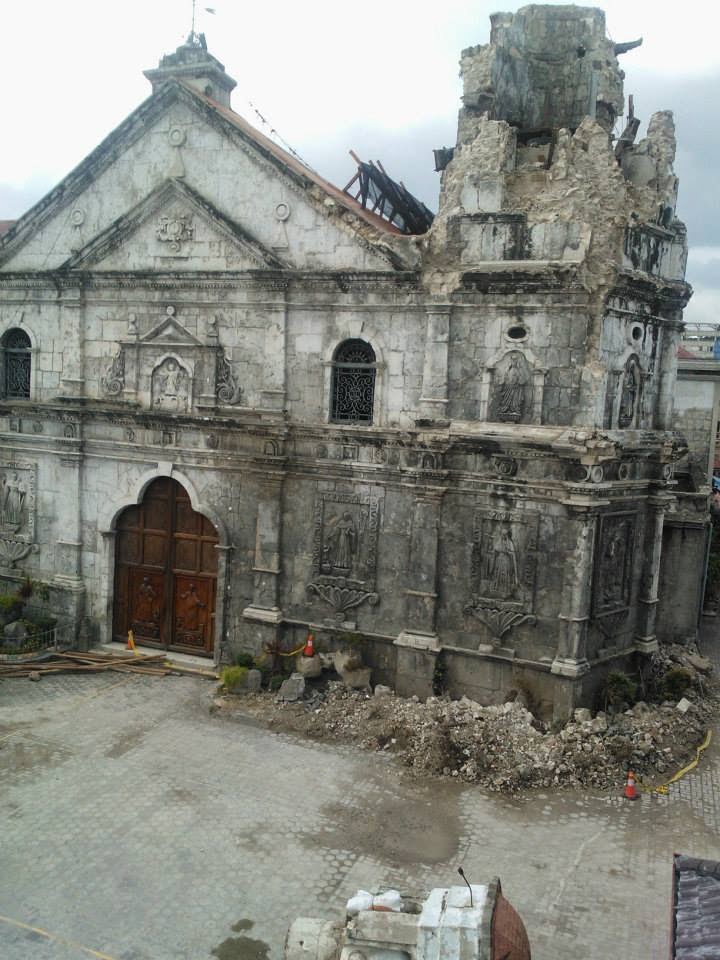
As the days went by, photos of the earthquake's extensive damage surfaced in the news, showing damaged houses, impassable roads and bridges that were lined by cracks, inoperable hospitals and government offices, and worst of all, fallen centuries-old churches.

When the opportunity to help came at work, I did not hesitate to leave the comforts of Manila and take risks as the prevailing news at that time prompted most people to expect the worst. (This was around two weeks before the Yolanda disaster.)

Arriving in Cebu on October 25, 10 days after the earthquake, my colleagues and I were greeted by some aftershocks---all of them I did not feel. Cebu seemed quick to recover. The half-hour ride from the Mactan airport to the Metrobank Fuente Osmeña Circle did not show any damage or signs of the earthquake affecting Cebuano's lives. It was, in fact, business as usual in Metro Cebu.

Bohol, however, was a different case.

Gaping cracks on the road from the Tubigon port
As the ferry docked in the Tubigon port, I followed a trail of cracks on a road that was made uneven by the earthquake. I joined about a hundred volunteers in one of the four distribution sites---Clarin, the town where my daughter's caregiver hails.

Miles and miles of damaged properties caught my sight as the bus drove from Tubigon to Clarin. I could not help myself from thinking about someone who I had not seen for quite sometime then. Despite all the issues that we could not settle, there was one thing that held us together even until that time. It was our passion for development work. Peering through the lens of my company-issued camera reminded me of how his photos looked after his community trips. It was as if I was looking at the community through his eyes.

A house with collapsed walls and ceilings

Shortly before reaching St. Michael Parish, the site of our relief distribution, a question crossed my mind:

Why does God allow bad things to happen to mankind?

I was seated in the pilgrim center within the courtyard of the Basilica Minore Del Sto. Niño in Cebu City a day later when an answer came.
Facade of the Basilica Minore Del Santo Niño,
the oldest church in the Philippines

God allows destruction so we may experience rebirth and so we may rebuild---back and hopefully, better.

I thought about Sodom and Gomorrah, the great ancient civilizations that were wiped out by either natural or man-made disasters, and nations that were once called as global super powers. Then I thought about relationships.

When all things just cannot seem to fall into place no matter how hard we try, we need a metaphysical collapse. From chaos, we need a momentary silence so God may work in ourselves. What feels like weeks, months or years for us is only a blink in the eye of God; a fraction of a second in the cosmos.

As the months went by, my reflections were enriched through several spiritual activities, which included some of my mindful walking, chi running and yoga practices, Monday fellowships and Ignatian prayer and share sessions, and recollections.

Yesterday, Fr. Mon Bautista, SJ shared a fitting theme in his Maundy Thursday recollection at Ateneo Rockwell, which has finally given a most proper push to my pen. He shared that spiritual conversion begins with a crisis, "a jolting, jarring experience," which can come in three ways: a sense of dissatisfaction, an experience of pain and sorrow, and a challenge of our faith.

"For you are dust, and to dust you shall return." (Genesis 3:19)

God allows bad things to happen -- our crises -- so we may be humbled; so that we may remember. 

Fr. Mon further explains that conversion entails letting go (of possessions, beliefs and habits) that once held us. And once we have let go, we embrace new ways of thinking, perceiving and beholding, which respectively translate to new ways of living, witnessing and loving.

And today, Good Friday, I think about God's only son, Jesus Christ, who He allowed to die on the cross not only for our sins, but to show us that in His resurrection, we may be reborn. In Christ's ministry, He spoke of tearing down the temple, which He will rebuild in three days.

Jesus answered them, "Destroy this temple, and I will raise it again in three days." (John 2:19)

For whatever Christ's statements intend to symbolize, I feel a glimmer of hope today as Pope Francis institutes changes in the way the Catholic Church responds to the issues that have been knocking on its doors for quite some time already.

It is humbling to finally find the courage and the patience to organize my reflections in the form of a blog post. It is, in fact, God's way of helping me remember the reason why I came back.

Tuesday, December 10, 2013

Holy Silence

http://www.ignatianspirituality.com/18276/zechariah-and-holy-silence/

"Sometimes our words, like Zechariah's, manifest our own limits. Silence makes room for the fullness of God's dynamic and healing power."

In this reflection on the story of Zechariah, we see how silence can sometimes be more powerful than words. We see how it can heal and bring about great changes in our lives.

I am reminded of the silence that pervades in a room after a mother's painful delivery. It is the same kind of silence which envelopes the mother and her infant when she feeds her child and puts her to sleep.

It is that soothing silence that we come into when, as we grow up, we learn to soothe ourselves from our own pains.

Silence is beautiful.

A blessed Advent to all... :-)

Sunday, November 24, 2013

Signing My Light Contract

Declaration to Me Contract 

I, JOYCE TALAG,
hereby commit to myself to connect daily to the vibration of Love and Above. I commit to purify, align and stabilize myself so that I am aligned with Love, Joy, and Consciousness, the most Loving Choice for myself. I choose Happiness, Fun and Ease in accomplishing my 30 day commitment to loving and honoring myself more, the practice of non-judgement, the attitude of gratitude, daily intuitive check in’s, and adding blessings to all relationships. I also commit to be nice to me while I am adding new skills to my Life.

I open to courageously Receive and Attract all the Gifts and Celebration this may bring me, as I deserve this!

I AM LOVED!

Signed: joycetalag
Dated: 24 November 2013

Thursday, October 24, 2013

The best gift that we can give our loved ones is the gift of our time.


Saying goodbye to my daughter happened quite in a hurry. What was it? Ten, fifteen minutes of quiet time, punctuated with some hugs and kisses and occasional I-Love-Yous.

Time never seems to be enough.

Physically, I wish that I can exist in a parallel universe - one for my career and the other one where my present self shall be is the universe that will be solely for my loved ones. But of course, it ain't gonna be a life worth living if it's too ideal.

In today's Gospel (Luke 12:54-59), Jesus calls on us to pay attention to the present time. Rev. Richard Gabuzda cites C.S. Lewis' work, The Screwtape Letters, in his reflection, highlighting "the importance of living in the present moment, while revealing the temptation of dwelling on the past, but, above all, the temptation which pulls us to focus on the future. "

One thing that mindfulness exercises and yoga have greatly helped me with is on keeping my mind to the present. Much of my recent stresses have been caused by phantoms -- ghosts of the past and invisible demons that haunt my future. I used to worry too much. I still do but I now have a better grip of my present reality. Perhaps, if I can make more time to practice mindfulness and maranatha meditation, my mind can finally switch from anywhere but here to nowhere but here.

Life is too short to waste on what never was and what couldn't be anymore. Yes, it is a very sad thought but I have been okay because I learned to live in and enjoy the present.


"Gratitude looks to the Past and love to the Present; fear, avarice, lust and ambition looks ahead."

- C.S. Lewis, The Screwtape Letters

Saturday, October 19, 2013

Acts of Mercy in Relationships

Blessed Teresa of Calcutta of our modern day epitomizes the acts of mercy.
Photo from http://mydrizzle.com/wp-content/uploads/2010/02/MotherTeresa2.jpg. 

As a young Catholic, I recall having to memorize the corporal and spiritual acts of mercy. The corporal acts, being bodily in nature, were quite easy to practice. Learning from the examples shown by my parents, I did not have a hard time holding on to material possessions and showing charity at a corporal level---that is, for the most part.

The corporal acts seem quite simplistic:
  1. Feed the hungry.
  2. Give drink to the thirsty.
  3. Clothe the naked.
  4. Shelter the homeless.
  5. Visit those in prison.
  6. Comfort the sick.
  7. Bury the dead.
I'd like to think that I have been a good follower of Christ through showing those acts of kindness even in times when my commitment to a relationship  -- whether platonic, romantic and without a question, on the parental level -- is being tested.

To some, however, this is not the case. It is easy to give when our hearts are whole but not when our hearts are either broken or hardened by disappointments and resentments. Being treated unmercifully by those whose welfare I have put ahead of my needs to the point that I have borne their own burdens and excess baggage as if they were my own have torn my heart into pieces. I have expressed hunger and thirst---only to be replied to with disdain and cold indifference. I have been sick -- very sick in mind, body and spirit -- only to be ignored and made to beg. It could be extremely violent in its passivity, much hurtful than feeling a fist land on my face. It is like being shot by a muffled gun while others watched for entertainment. Figuratively, I had to bear the cruelty of words and inappropriate humor being hurled against me as I fell on my knees. Alone.

Hurtful as they were, I still would not ask God to reverse such experiences. Never have I looked upon a beggar on the street asking for alms with the same compassion as I do now because of what I have gone through. (Imagine how it must feel like for innocent kids with grumbling stomachs to knock on the windows of hundreds of cars under the heat of the sun or the cold of the rain for a meaningless peso.) It is not true after all that cruelty begets cruelty; in some mysterious ways, experiencing selfishness can lead to greater charity.

As I grow in the realm of my body, I realize that I have to take on a much harder challenge as I seek to grow in spirit. The spiritual acts of mercy when viewed as a child seems just as easy as the corporal acts:
  1. Share knowledge.
  2. Give advice to those who need it.
  3. Comfort the suffering.
  4. Be patient with others.
  5. Forgive those who hurt you.
  6. Give correction to those who need it.
  7. Pray for the living and the dead.
My own body with its temporal needs has often betrayed my spirit and its capacity to show mercy through the spiritual acts. At the times when they seem easy to practice, it is usually because of the following reasons: it wasn't too hurtful to begin with; it doesn't involve a person I care about very much; and I may have been doing it at a very superficial level. The same must hold true for those who fail to be charitable in spirit. Perhaps the secret is for me to have the heart of a child: innocent, simple and free.

Taking this refresher on the acts of mercy is a good reminder of the duplicity of my human existence---that I exist both in body and in spirit. Each can constrain the other from opening itself to enable generosity to flow to a co-being. Learning from the Buddhist tradition, however, should prevent us from taking this duplicity as a basis for conflict; instead, it should present us the opportunity to be creative in finding ways to harmonize the needs and the capacities of the corporal and the spiritual. After all, this is a truth in our reality as creatures of God. This is a truth in the context of Christ's presence on earth: He is both human and divine, existing in body and in spirit.

In closing, allow me to juxtapose today's reflection with some relevant lines from a book which I am currently re-reading, "The Unbearable Lightness of Being" by Milan Kundera --

"... The heavier the burden, the closer our lives come to the earth, the more real and truthful they become.

Conversely, the absolute absence of a burden causes man to be lighter than air, to soar into the heights, take leave of the earth and his earthly being, and become only half real, his movements as free as they are insignificant."

A blessed Sunday to all!